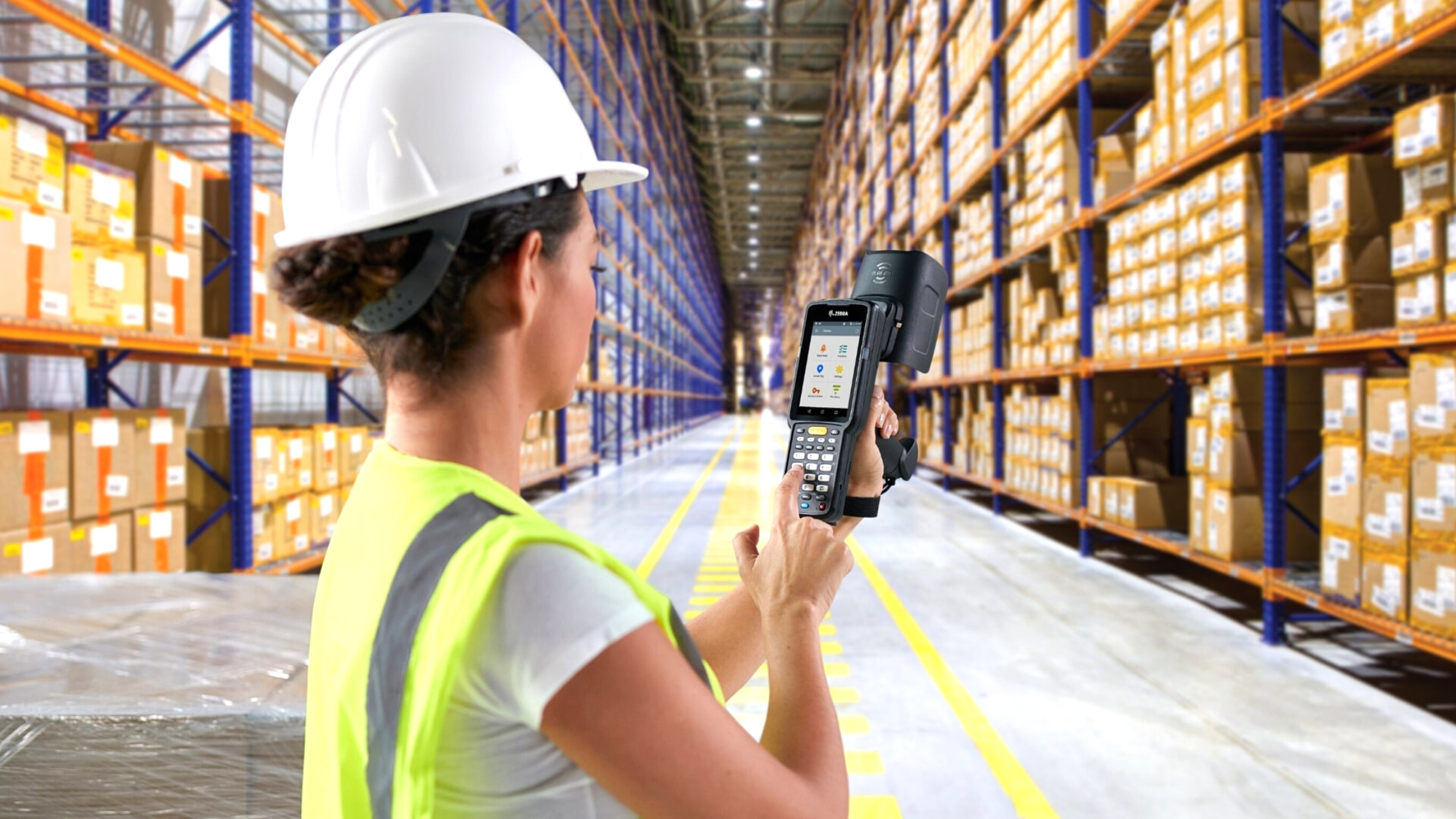
Real-time inventory, picking error reduction and end-to-end traceability across the goods flow.
18+years of RFID experience
140+logistics and warehouse projects
10 mUHF read range
Challenges we understand
Operational challenges in your industry
Slow, inaccurate inventory counts
Manual stock checks take hours and generate errors that propagate throughout the supply chain.
Picking and shipping errors
Wrong or missing items drive costly returns, complaints and loss of customer trust.
No real-time visibility
Without live traceability, stock levels are always an approximation and replenishment always arrives late.
Table of contents
RFID tags for logistics and warehouse: real inventory, error-free picking, end-to-end pallet traceability
Manual inventory blocks operations for hours, produces errors that propagate throughout the supply chain and is already obsolete by the time it is printed. Picking errors drive costly returns and complaints. A pallet stranded in the wrong aisle — while the system marks it as shipped — is exactly the kind of invisibility no logistics operator can afford in a market where customers expect real-time traceability.
Wintag manufactures RFID labels and tags specifically for logistics: long read range for entry/exit gate portals, impact resistance on pallets and metal containers, custom encoding for direct WMS and ERP integration without intermediate adapters.
Our customers in this sector include 3PL logistics operators, supply chain and warehouse managers at manufacturing companies, large distribution operators with high-volume receiving bays, and — frequently — system integrators implementing WMS solutions who need a reliable tag supplier to integrate into their project.
RFID gate portals: automated receiving, shipping and cross-docking
Bulk reading without operator intervention
An RFID portal positioned at the loading bay reads all tags on a passing pallet — dozens of cartons in a single pass, no manual scanning, no stopping the forklift. The data enters the WMS at the exact moment the goods cross the threshold, not when an operator finds time to register it. In distribution centres with dozens of active bays running in parallel, this translates into hours of saved labour every day.
Automated order verification and exception management
The comparison between the expected order and what the portal has read happens in real time. A discrepancy — a missing carton, a wrong item — generates an immediate exception before the truck leaves. Errors managed at the receiving dock drop dramatically, along with disputes between suppliers and end customers.
Cross-docking without bottlenecks
In warehouses running cross-docking flows — where inbound goods are sorted directly for outbound shipping without intermediate storage — RFID reading at the inbound portal identifies arriving cartons and automatically assigns them to the correct outbound bay. The result: reduced transit times and lower risk of sorting errors even at high volumes.
RFID inventory: from days to hours, from estimates to certainty
Bulk inventory with a handheld reader
An operator with a handheld RFID reader scans aisles without touching products: reading hundreds of tags per minute through packaging, without requiring direct line of sight on every carton. An inventory that previously required a full working day — with the warehouse locked to operations — is completed in a few hours, with accuracy above 99% versus the 65–70% typical of a manual count.
Continuous cycle counting instead of periodic inventory
With RFID there is no need to wait for the annual or half-yearly stocktake to know what is in the warehouse. Cycle counting — a rolling check of areas or product categories — becomes feasible on a daily basis without any operational impact. Discrepancies are identified and corrected continuously, before they become order fulfilment problems.
Real stock levels in real time
Every movement — receiving, picking, return, transfer between warehouses — automatically updates the stock in the WMS. The system no longer shows the snapshot from the last inventory three weeks ago: it shows the current situation, updated with every recorded event.
WMS and ERP integration: data that arrives without manual intervention
Encoding configured for the destination system
The RFID tag is not just a label: it carries an EPC encoded according to the structure required by the destination WMS or ERP. Wintag works with system integrators to define the encoding structure before production — not after. Changing encoding on an already produced batch means starting over, with costs and delays that ripple through the entire project go-live.
Guided picking and reduction of shipping errors
Integrated with the WMS, RFID enables guided picking: the terminal indicates the exact location of the carton, the pick is confirmed by reading the tag, the order closes without manual typing. Shipping errors — wrong items, wrong quantities, incomplete orders — are significantly reduced compared to traditional picking guided only by barcode or paper.
Compatibility with major WMS and ERP platforms
The EPC Gen2 protocol (ISO 18000-6C) is supported by all major WMS platforms on the market. The EPC structure — filter, partition, GS1 company prefix, item reference — is defined in accordance with the customer's system specifications. Wintag provides pre-encoded samples for the testing phase before series production, reducing the risk of integration incompatibilities at go-live.
RFID labels and tags for pallets and cartons: the technical requirements that matter
An RFID label for logistics must perform in conditions that an office tag would not survive for a day. The concrete requirements for a high-volume warehouse:
Long UHF read range: reading from 3–8 metres for entry/exit gate portals and bulk inventory with a handheld reader. Effective range depends on the inlay and the presence of metal or liquids in the pallet.
Adhesion on cardboard, plastic and metal: steel pallets and reusable metal containers require on-metal tags with integrated standoff layer; corrugated cardboard accepts standard labels with inlays optimised for long-range reading.
Impact and handling resistance: the label must survive forklift and pallet truck handling cycles without delamination or edge lifting.
On-demand printer compatibility: substrate suitable for direct thermal or thermal transfer printing for on-site encoded labels, with GS1 barcode alongside RFID where required by the customer's supply chain.
EPC Gen2 compliance (ISO 18000-6C): the standard protocol for interoperability with all major readers and WMS systems in the European market.
Resistance in temperature-controlled environments: cold stores and below-zero cells require substrates and adhesives formulated to withstand thermal cycling and condensation from temperature shocks.
Are you a system integrator implementing WMS solutions with RFID?
Many of our contacts in logistics are not warehouse managers directly, but system integrators tasked with implementing the WMS who need to choose — or replace — the physical tag to integrate into the project. For an SI, the tag is not a secondary component: a tag that does not read reliably on the customer's actual surface blocks the entire go-live.
Wintag supports system integrators with:
Encoding configured to WMS specifications: EPC structure, User Memory and TID defined in agreement with the destination system before production, not after.
Samples for field reading tests: we provide prototype tags and labels to validate on the actual reader hardware and the customer's real surface (cardboard, metal, plastic) before the series order.
Technical support during integration: we solve reading problems together before go-live — without deferring issues to the production phase or post-installation.
Continuous and reliable supply: once the tag is defined and validated, we guarantee series supply with consistent quality over time — critical for SIs managing distributed roll-outs across multiple warehouses in successive phases.
How Wintag works in logistics and warehouse
Before any proposal, Wintag analyses the context: surface type (cardboard, plastic, metal), application method (manual, automated, on-demand printing), required read range, warehouse operating temperature, WMS system and encoding structure needed. Only then is the product defined.
Custom encoding: EPC structure configured for direct integration with your WMS or ERP, defined and validated before series production.
On-demand print labels: substrates compatible with thermal RFID printers, with GS1 barcode alongside where required by the customer's supply chain.
Samples for validation: we provide prototype labels and tags to test in your environment — on the real surface, with the actual reader — before the series order.
Frequently asked questions about RFID tags for logistics
What read range does a UHF RFID label achieve on a pallet?
A UHF RFID label (EPC Gen2, ISO 18000-6C) applied to cardboard or plastic typically achieves 3–8 metres read range with fixed gate readers. Effective range depends on the chosen inlay, label orientation, presence of metal or liquids in the pallet and the power configured in the reader. Wintag selects the inlay after verifying the actual conditions of your environment — not from a standard catalogue.
Are RFID tags compatible with the WMS system already in use?
Compatibility depends on the encoding, not the hardware. Standard UHF RFID tags (EPC Gen2) are recognised by any reader and WMS system on the market. What needs to be configured is the EPC structure according to the format expected by your WMS. Wintag defines this structure with you before production, verifying compatibility with pre-series samples validated on your system.
Should I use RFID labels on pallets or rigid tags for reusable containers?
It depends on the surface and the container lifecycle. RFID labels are ideal for pallets and single-use or fast-rotation cartons, where low unit cost is the priority. Hard tags are the right choice for reusable metal containers, crates and pallet pools where the tag must last years, withstand handling impacts and guarantee reliable reading on metal surfaces.


 Italiano
 Français
 Español
 Deutsch