Lifting accessory traceability, automated periodic inspections and regulatory compliance in demanding industrial environments.
18+years of RFID experience
20+clients in the lifting sector
EN 818-7standard supported
Challenges we understand
Operational challenges in your industry
Out-of-certification accessories in use
Without unique identification there is no way to know if a hook or sling has passed its periodic inspection. A concrete legal and safety risk.
Paper-based inspection records
Manual inspection logs get lost, deteriorate and cannot withstand an audit. EN 818-7 leaves no margin for error.
Slow and inaccurate manual inventory
Physically counting hooks, slings and shackles in a depot takes hours and still produces errors. Missing accessories are only discovered when needed.
Table of contents
RFID tags for lifting accessories: EN 818-7 compliance, rapid inventory and below-the-hook safety
An out-of-certification hook used because it "still looks fine", a sling that cannot be found during an inspection, a chain whose last inspection date nobody remembers: these are not theoretical risks. These are incidents that happen when lifting accessory traceability is manual and dependent on operator discipline.
The RFID tag applied to every accessory — hook, sling, chain, shackle, spreader beam, harness — associates the physical object with its complete history: Working Load Limit (WLL/SWL), serial number, CE marking date, last periodic inspection, next inspection deadline. The data is readable in the field with a handheld reader or NFC smartphone, without consulting paper registers or tracking down the file in the office.
The sectors where we operate most frequently: construction and industrial sites, steel mills and foundries, ports and port logistics, crane and overhead crane maintenance. Our customers include safety managers, rigging supervisors, lifting accessory rental companies, OEM manufacturers of hooks and slings, and inspection bodies (Dekra, TÜV, Bureau Veritas) managing periodic inspections.
Regulatory compliance: EN 818-7, EN 1677 and workplace safety regulations
Mandatory periodic inspections of lifting accessories
Workplace safety regulations in most EU member states require employers to subject lifting accessories to mandatory periodic inspections, typically on an annual basis for most categories. Failure to document these inspections is a sanctionable violation in regulatory inspections. With RFID traceability, every inspection is recorded at the moment it happens: operator, date, result, next deadline. The register is digital, updated in real time and available for any inspection without searching through folders.
EN 818-7 for chains and EN 1677 for sling components
European product standards define the safety and marking requirements for lifting chains (EN 818-7) and metallic components of slings (EN 1677). The RFID tag carries with it the compliance data of the individual piece: serial number, WLL (Working Load Limit), CE marking date, material class. The link between the physical accessory and its technical file is unique, verifiable in the field and tamper-proof.
Cranes and overhead cranes: mandatory inspection register
For cranes, overhead cranes and hoists, regulations provide for periodic inspections by approved bodies. The RFID tag applied to the lifting equipment becomes the immediate access point to the inspection register: every inspection is recorded at the very moment it happens, without depending on subsequent manual compilation.
Rapid inventory, inspection register and complete history: all automated
Bulk inventory without manual counting
An operator with a handheld RFID reader scans the accessory depot and reads dozens of tags in seconds, even on metal objects and without direct line of sight. The inventory that previously required hours — manual counting, tag plate verification, spreadsheet updating — completes in minutes with total accuracy. The location of every hook, sling or harness is known to the system, regardless of where it physically is in the depot or on site.
Digital register for every accessory: WLL, deadlines and inspection history
For every tagged accessory, the system maintains a digital register including: certified WLL/SWL, serial number, first-service date, history of all periodic inspections performed with result and operator, and next inspection deadline. This register is the digital equivalent of the physical maintenance booklet required by regulations, automatically updated at every intervention.
History by site and customer: accessories tracked throughout the chain
Every use, every issue from and return to the depot, every transfer from one site to another is recorded in the system at the moment it happens. The digital history of every accessory — who used it, when, on which site, how many load cycles — is available in real time, without depending on manual operator entry.
The main risk in lifting is not the visibly broken accessory: it is the accessory with an expired inspection that is used anyway because "the compliant one cannot be found" or because nobody checked the register. With RFID traceability integrated with the management software:
Automatic alert before expiry: the system signals accessories whose periodic inspection is approaching its deadline — configurable with 30, 60 or 90 days' notice — without depending on the safety manager's memory.
Automatic blocking of expired accessories: accessories with expired inspections are flagged as unavailable in the system, regardless of their physical location in the depot or on site.
Immediate field identification: the technician or supervisor reads the tag with the handheld reader and immediately sees whether the accessory is compliant, expired or awaiting inspection — without consulting office registers.
Documentation ready for audits: in the event of an inspection by regulatory authorities or customers, the complete history of every accessory with all documented inspections is available in real time, not collected retrospectively.
The tag on a hook, sling or chain: the real technical requirements
A lifting accessory works on construction sites, in foundries, in port warehouses, under an overhead crane in a steel mill. The conditions of a tag applied to a hook or chain are incompatible with any standard catalogue tag:
Impact and vibration resistance from load cycles: every lift is a repeated mechanical stress; the tag must survive hundreds of cycles without detaching or losing readability, even under dynamic loads.
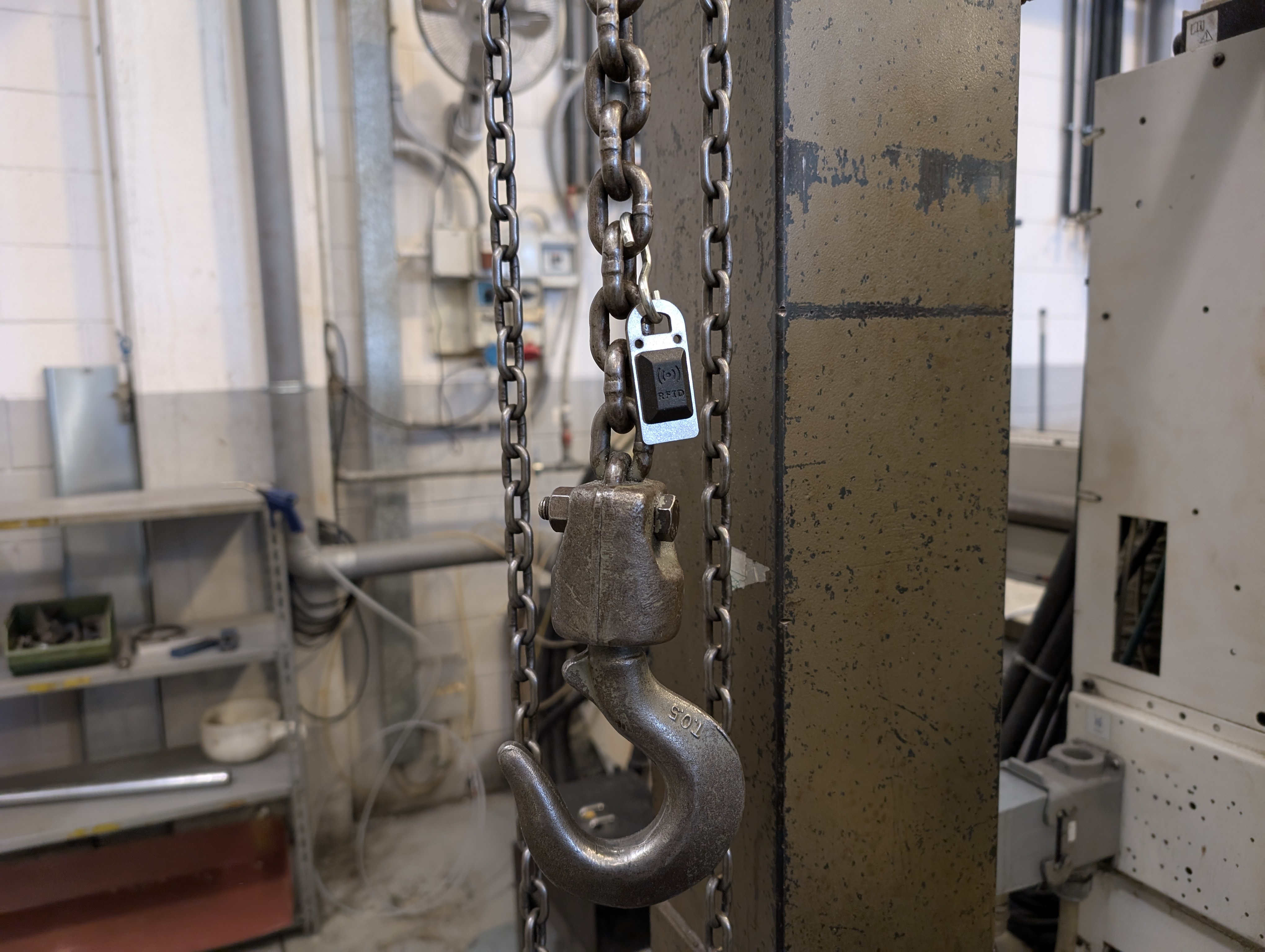
Guaranteed on-metal reading: hooks, chains, shackles and spreader beams are entirely steel; a tag with an integrated standoff layer is needed for stable reading on the metal surface, both with a UHF handheld reader and with an NFC smartphone.
Resistance to oils, lubricants and solvents: accessories are regularly lubricated and sometimes exposed to cleaning solvents; the tag must withstand continuous exposure without degrading the inlay.
Resistance to radiant heat in foundries and steel mills: in environments with metal casting or heat treatment, the tag is exposed to radiant heat that can exceed 100°C at the surface; substrates and encapsulations verified for these ranges are required.
Corrosion resistance in maritime and port environments: prolonged exposure to salt air and humidity requires IP68-protected substrates and inlays, and anti-corrosion materials.
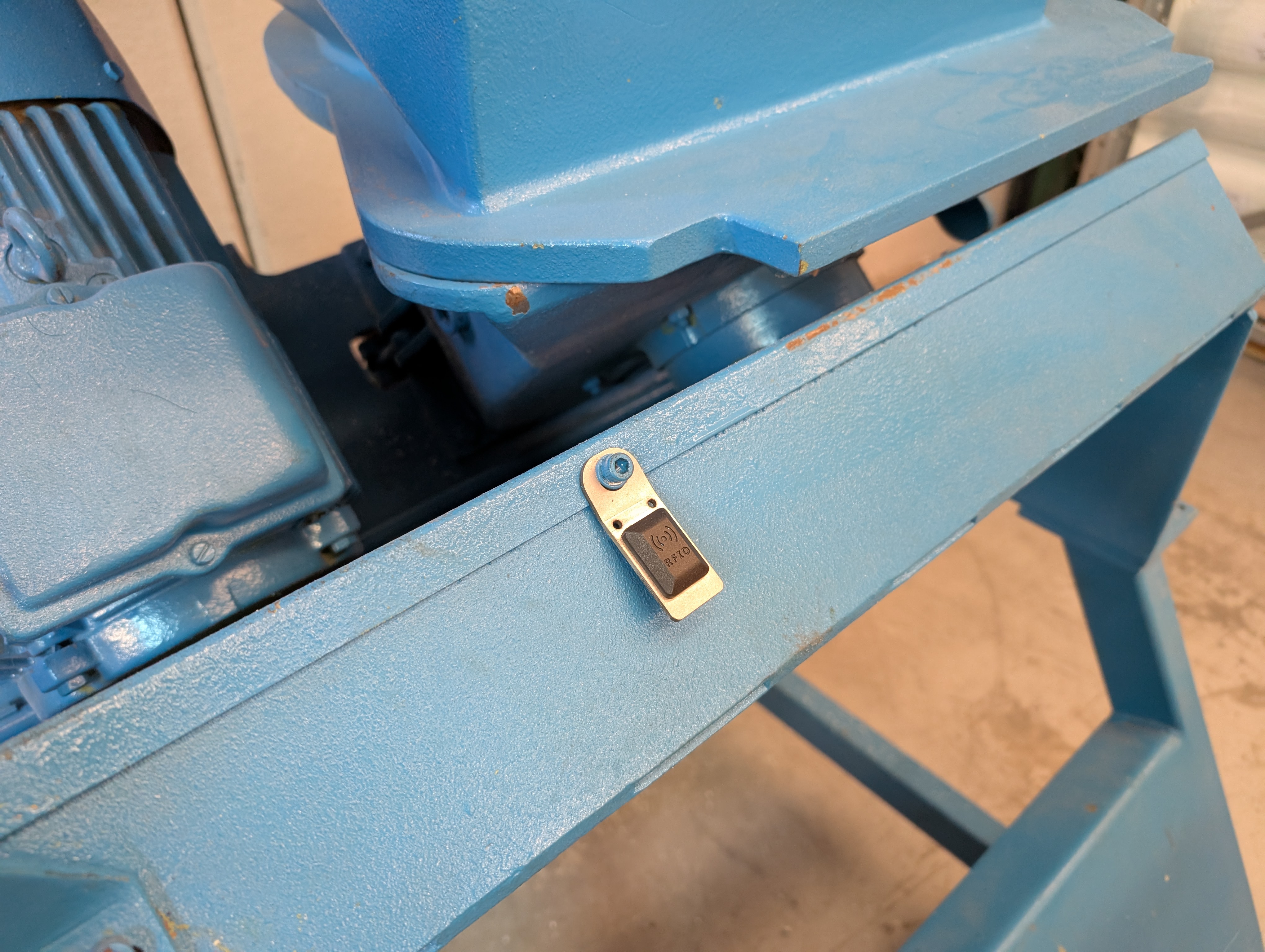
Permanent fixing: the fixing method (structural adhesive, rivet, threaded insert, material embedding) is chosen based on the accessory geometry and its specific operating cycle.
Are you an accessory manufacturer or a rental company?
For OEM manufacturers of hooks, slings, chains and spreader beams, Wintag is a component supplier: the RFID tag is designed and pre-mounted in production, so the accessory reaches the customer already tagged with the associated digital technical file from first delivery. Nameplate data — WLL/SWL, serial number, material class, first-service date — are encoded in the tag memory during the manufacturing phase, before the piece leaves the plant. The link between the tag and the CE Declaration of Conformity is unique and immutable.
For lifting accessory rental companies the problem is different but equally critical: managing hundreds of items rotating between sites, customers and the depot, with different inspection deadlines for each one and no real-time visibility of where they are. The RFID tag applied at stock-in transforms the rental fleet into a digital inventory readable in seconds: location of every piece, certification status, expected return date, approaching deadlines. Site collection is done by reading the tag, not by searching for the plate or calling the site foreman.
In both cases, Wintag develops the tag format, encoding layout and fixing specifications based on the specific lifecycle of the accessory: frequency of use, operating environments, reading method adopted by the end customer or inspection body.
How Wintag works in the lifting sector
Before any proposal, Wintag analyses the specific accessory: material (steel, alloy, polyester), geometry, operating conditions, chemicals and thermal agents present, field reading method (fixed UHF reader, handheld, NFC smartphone). Only then is the right tag, fixing and encoding defined for that accessory.
On-metal tags for hooks, shackles and steel spreader beams: integrated standoff layer for stable reading at 30 cm – 1 m with UHF handheld readers.
RFID labels for polyester and nylon slings: flexible substrate with structural adhesive or anchor strap, for textile slings subject to bending.
Encapsulation for harsh environments: resistance to impacts, oils, solvents, radiant heat and marine corrosion — verified before series supply.
Encoding with WLL, serial number and deadlines: data structure configured for integration with CMMS, ERP or specialist software for lifting inspection management.
Pre-encoded tags for OEM manufacturers: nameplate data (WLL, class, CE) written in production before delivery to the end customer.
Samples and tests on the real accessory: prototype tags to apply to your equipment fleet and verify under operating conditions before the series order.
Frequently asked questions about RFID tags for lifting equipment
Does the RFID tag on a lifting accessory satisfy EN 818-7 and EN 1677 requirements?
EN 818-7 and EN 1677 define the safety and marking requirements for chains and sling components, but neither prohibit nor prescribe specific electronic identification methods. The RFID tag is an additional traceability means: regulatory compliance depends on the manufacturer's design and technical documentation. Wintag supplies tags with data structure compatible with the fields required by the standard (WLL/SWL, serial number, first-service date, material class), facilitating management of the mandatory technical file.
How is RFID reading guaranteed on entirely metal accessories such as hooks and shackles?
Metals absorb and reflect RF fields, eliminating the reading of a standard tag applied directly to the surface. Wintag on-metal tags integrate a dielectric standoff layer that separates the antenna from the metal, restoring reading conditions. The typical range in on-metal configuration runs from 30 cm to over 1 metre with UHF handheld readers — sufficient for manual field reading during inspections. Before the series supply, Wintag performs reading tests on the customer's actual accessory under specific operating conditions.
What is the most appropriate fixing method for a tag on a sling or chain subject to impacts?
Fixing depends on the geometry and material of the accessory. For polyester or nylon slings, a flexible RFID label with structural acrylic adhesive is used, applied on a sewn or welded protective strap. For metal chains and hooks, a rigid encapsulated tag fixed with rivet or M4/M6 threaded insert is preferred, unaffected by repeated vibrations. For OEM production accessories, tags can be embedded directly in the manufacturing process. Wintag assesses every case and provides samples to test before the final order.
What is the periodic inspection procedure required by workplace safety regulations for lifting accessories?
Workplace safety regulations in EU member states classify lifting accessories among equipment subject to mandatory periodic inspections, typically with annual frequency for most categories. First inspections are carried out by appointed authorities; subsequent inspections by approved bodies. RFID traceability simplifies this procedure: the inspection technician reads the accessory tag, accesses its history and records the inspection result in real time in the system, automatically generating the next deadline date and required documentation.


 Italiano
 Français
 Español
 Deutsch