

 Italiano
 Français
 Español
 Deutsch
RFID Application Sectors
RFID Tags for Waste Management & Smart Collection
Container traceability, TARIP billing and regulatory compliance with no concessions on environmental conditions.
Challenges we understand
Operational challenges in your industry
Unverifiable collection events
Impossible to prove which containers were emptied, when or how many times. Disputes are guaranteed.
Tags that cannot survive the environment
Moisture, dirt, impacts and UV degrade standard tags within months. Constant replacements and uncontrolled costs.
Difficult PAYT implementation
Without reliable container identification, it is impossible to calculate the per-collection tariff correctly.
Table of contents
RFID tags for waste containers: outdoor durability, PAYT traceability and separate collection
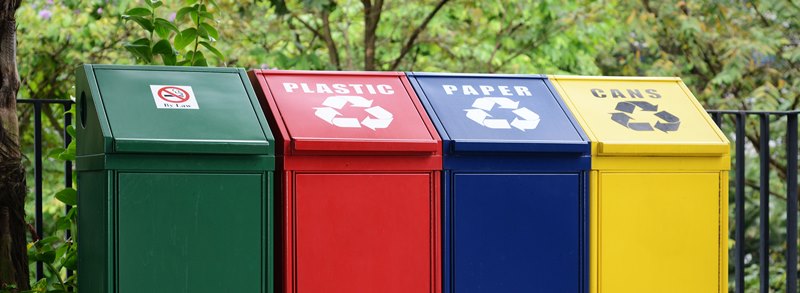
In urban waste management the RFID tag is the component nobody sees but that makes everything else work: door-to-door Pay-As-You-Throw billing, street bin inventory, collection event monitoring for urban hygiene. When the tag fails — through adhesive peeling, UV degradation or mechanical arm impacts — the data flow breaks and the traceability system loses reliability.
Wintag manufactures RFID tags specifically for outdoor waste containers: IP68 encapsulation, certified UV resistance, adhesives verified for HDPE surfaces, impact resistance from automated tipping. Every tag is designed to last as long as the container it is mounted on.
Our customers include municipalities, waste management authorities, urban hygiene service operators and collection fleet managers — and increasingly, container manufacturers for separate collection who integrate the tag directly in the factory before delivery.
Tag durability is the real challenge in waste management
Why standard tags fail outdoors
A standard tag applied to a street bin works in conditions no generic tag is designed to withstand: thermal cycles from −20°C to +60°C, years of continuous UV exposure, moisture and condensation, high-pressure washing, mechanical impacts at every emptying cycle. The failure points are always the same: adhesive peeling due to UV and thermal cycling, inlay delamination from moisture infiltration, physical encapsulation cracking from repeated impact with the mechanical arm.
Verifiable technical requirements, not generic specifications
A tag for a waste container must meet precise requirements:
- IP68 encapsulation (continuous immersion beyond 1 metre): protects the inlay from water, moisture and high-pressure washing.
- UV resistance to ISO 4892-2: stabilised substrates and encapsulation that maintain mechanical properties throughout the container's operational life.
- Thermal range from −25°C to +70°C: covering both winter nights and summer bins exposed to direct sunlight.
- Structural acrylic adhesive for HDPE: HDPE has low surface energy; most adhesives do not guarantee permanent adhesion. Wintag selects formulations specific for polyethylene, with primer where necessary.
- Impact resistance from automated tipping: the collection vehicle's mechanical arm applies significant force at every emptying. The tag must withstand thousands of cycles without detaching or losing readability.
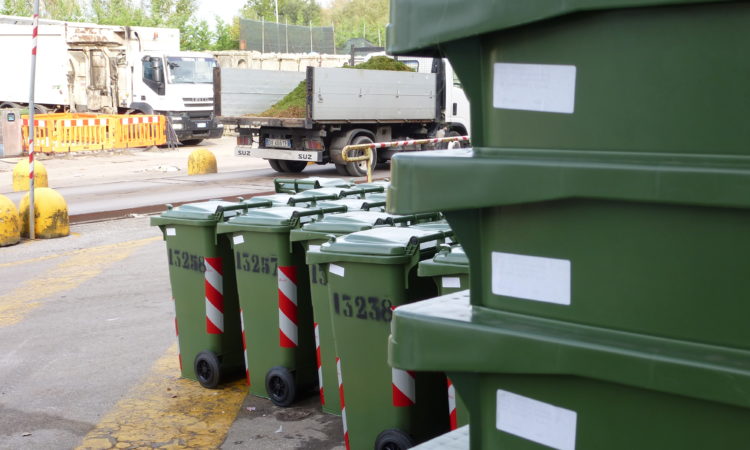
RFID and Pay-As-You-Throw (PAYT): how the system works
Pay-As-You-Throw (PAYT) is the tariff system that calculates what each user pays based on the actual quantity of residual waste produced, rather than a fixed quota tied to property size. European waste policy is driving rapid adoption of RFID traceability systems in urban hygiene across all EU member states.
The RFID tag on the container is the cornerstone of the system: when the collection vehicle lifts the bin, the RFID reader installed on the arm or at the rear of the vehicle reads the tag in motion — without precise alignment, without operator intervention — and logs the event with date, time and container ID. The data feeds into the municipality's management software, which uses it to calculate the variable portion of the tariff and maintain a complete log for every household.
For the system to work at municipal scale, the tag must guarantee reliable reading in any real-world condition: vehicle in motion, wet container, variable reading angle, direct sunlight or heavy rain. A tag not designed for this context produces missed reads that translate into billing errors and citizen disputes.
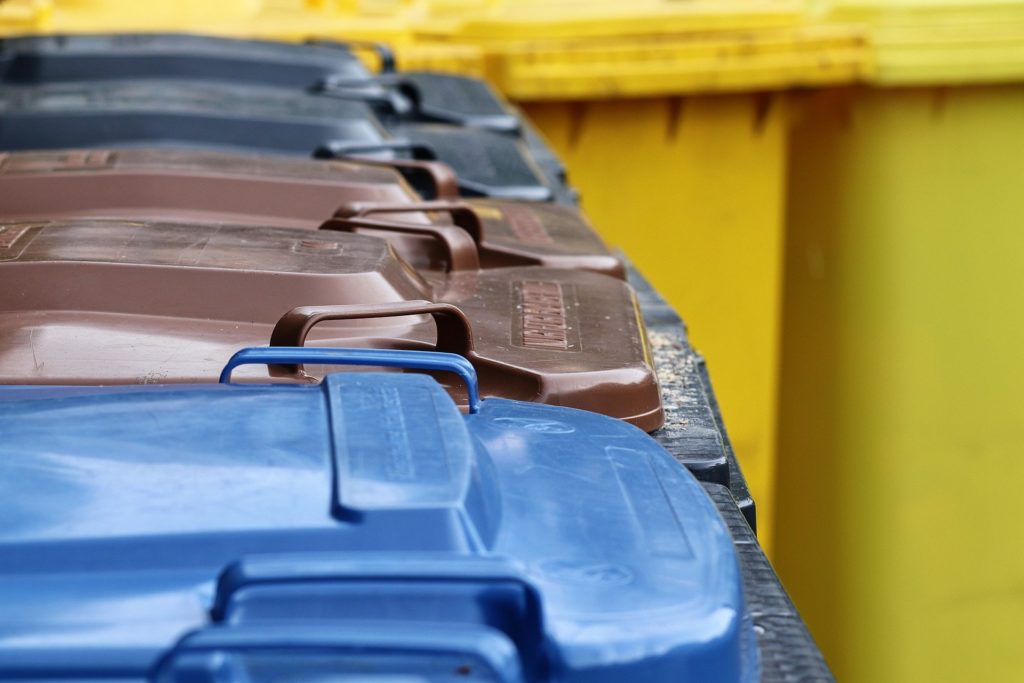
Door-to-door collection and smart bins: the two RFID scenarios
Two main collection models coexist in European waste management, each with distinct RFID needs:
Door-to-door collection (residential)
Each household has one or more individual bins identified by an RFID tag. The collection vehicle reads the tag at every pick-up: the system records which user put out which waste fraction, how many times during the month. This is the operational basis of PAYT — without reliable reading of every bin at every emptying, the per-collection tariff cannot function.
In this scenario the tag works on 40 to 360-litre HDPE bins, exposed outdoors, mechanically tipped hundreds of times a year. Critical requirements are impact resistance from automated tipping and permanent adhesion on polyethylene, plus UV durability for the entire bin life.
Street bins and communal containers
Street bins — 660 to 3,200 litres — require tags with a wider read field (the vehicle arm is further away), greater resistance to urban traffic impacts and vandalism, and attachment that holds even against repeated lateral impacts.
Glass and textile banks present specific requirements: different materials (galvanised steel, fibreglass), permanent placement on public ground, high-frequency impact from manual waste insertion. In this case the tag is often embedded in the structure during container manufacturing, not applied as an adhesive afterwards.
Outdoor resistance for waste containers: the real technical requirements
UV protection and thermal stability
UV exposure degrades standard polymers in 12–18 months, causing substrate embrittlement and inlay delamination. Wintag tags for outdoor use on waste containers use UV-stabilised substrates to ISO 4892-2 and structural acrylic adhesives formulated to resist thermal cycling from −25°C to +70°C, maintaining mechanical properties for the entire operational life of the container — typically 10 years and beyond.
Adhesion on HDPE, polypropylene and galvanised steel
HDPE has low surface energy and repels most commercial adhesives. Wintag selects acrylic adhesive systems verified for permanent adhesion on polyethylene, with primer applied to the surface when necessary. The same approach is adapted for polypropylene, ABS and galvanised steel, the most common materials in glass banks and large street containers.
Fixing method based on container type
Not all containers accept an adhesive tag. For steel banks and containers permanently installed on public ground, the tag is embedded in a housing machined into the structure during manufacturing, or riveted. For HDPE bins with a defined lifecycle, structural adhesive with primer is the most effective solution. Wintag assesses the method case by case, based on the specific container and the operating conditions of the municipality or service operator.

Operational benefits of RFID in waste management
- Automatic collection event traceability: every collection is logged with a timestamp and container ID, without manual intervention — eliminating errors typical of paper records and manually updated databases.
- Data basis for PAYT billing: complete and verifiable log of every emptying per household, exportable for per-collection billing and consultable in case of citizen dispute.
- Route optimisation: RFID data identifies containers emptied at abnormal frequency — too often or never — enabling route recalculation and elimination of empty runs, with direct reduction in operating costs.
- Automatic container fleet inventory: every bin and street container is uniquely identified — last read GPS position, status, installation date, total emptying count — always up to date without periodic manual surveys.
- Reduction of tariff disputes: with RFID logging of every collection event, the municipality or operator has a verifiable log to respond to any citizen dispute about the applied tariff.
- Tag operational life aligned with container life: tags designed for outdoor use on bins have an operational life of 8–12 years under real conditions — in line with the average bin or container life, without the need for early tag replacement.
Are you a manufacturer of separate collection containers?
Many of our customers are not municipalities or service operators, but companies that manufacture bins, glass banks and separate collection containers and supply them already equipped with integrated RFID tags. For a container manufacturer, the tag is not an optional accessory: it is a component of the finished product, which must be as reliable as the container itself — and compatible with RFID systems already adopted by the destination municipalities.
Wintag supports container manufacturers with:
- Continuous OEM supply: tags manufactured in series with consistent quality, scheduled deliveries based on the customer's production volumes.
- Pre-encoded tags: every delivered tag carries its own unique code ready for registration in the destination municipality's system.
- Compatibility with major PAYT software: encoding configured for integration with the most widely used tariff management software in European municipalities.
- Samples and tests before production line integration: we validate the tag on the specific container before moving to series production, verifying adhesion, readability and mechanical resistance in the assembly process.
How Wintag works in waste management
Before recommending a tag, Wintag analyses the specific context: container type (glass bank, street bin, door-to-door bin), emptying method (lateral arm, rear tipper, manual), environmental exposure, existing RFID on-board system on the vehicles and management software in use. Only then is the right tag defined.
- IP68 RFID tags for continuous outdoor use: waterproof encapsulation, UV resistance, stabilised substrates for extended thermal range.
- Certified adhesives for HDPE and low-energy surfaces: verified for permanent adhesion on the surfaces of major separate collection container manufacturers.
- Encoding for PAYT systems and municipal management software: configurable data structure for integration with the tariff management software already adopted.
- OEM supply for container manufacturers: pre-encoded tags ready for production line integration.
- Samples for field durability tests: we provide prototype tags to install on the real container and test on the collection vehicle before the series order.
Working on a waste management or separate collection project? Tell us about it →
Frequently asked questions about RFID tags for waste management
- How long does an RFID tag last on an outdoor waste container?
- A Wintag tag designed for outdoor use on bins has an operational life of 8–12 years under real conditions, thanks to IP68 encapsulation, UV-stabilised substrates to ISO 4892-2 and structural acrylic adhesives formulated for HDPE surfaces. Standard catalogue tags typically do not last beyond 12–18 months under the same conditions.
- Are door-to-door collection RFID tags compatible with existing on-board vehicle systems?
- It depends on the on-board reading system and management software adopted by the municipality or service operator. Wintag manufactures tags in the most common protocols used in European urban hygiene systems (UHF EPC Gen2 – ISO 18000-6C, HF ISO 15693) and configures the encoding based on the PAYT software already in use. If you tell us which system you have adopted, we verify compatibility with pre-series samples before any supply.
- Do RFID tags permanently adhere to HDPE and polypropylene bins?
- Yes, but they require an adhesive system specific to this type of surface. HDPE has low surface energy and repels most common adhesives: after a few use cycles the label lifts at the edges and reading becomes unreliable. Wintag uses primers and structural acrylic adhesives verified for permanent adhesion on polyethylene and polypropylene, the most common materials in door-to-door bins and street containers.
Working on a project in the Waste Management sector?
Tell us about your requirements. A Wintag engineer will get back to you within 24 hours with a concrete assessment.
Got an RFID project?
Let's talk.
Describe your requirement and a Wintag engineer will get back to you within 24 hours with a concrete assessment — no commitment required.